
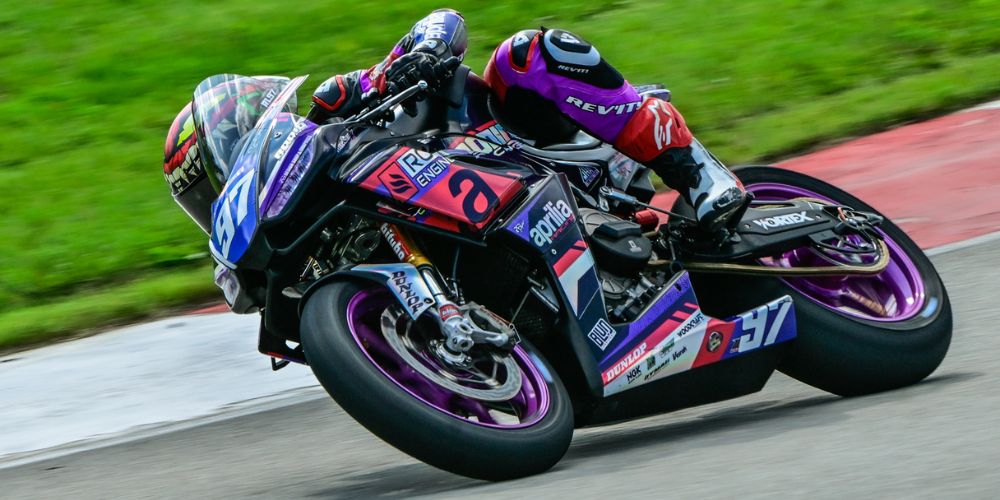
Why does a racing or high-performance powersports engine need a racing oil, and how do I choose one?
- Racing can expose an engine’s oil to sustained high RPM, heavy loads and elevated temperatures.
- Look at measured numbers, not marketing: viscosity at 40°C and 100°C, viscosity index (VI), high-temperature high-shear (HTHS) viscosity and flash point.
- Choose by viscosity and OEM recommendation. Your owner’s manual or engine builder has the final say; the Blud Powersports Viscosity Guide lists typical grades.
- Barracuda Blud™ and Scorpion Blud™ are 100% synthetic racing oils for powersports. All Blud moto oils are formulated for JASO specs.
01What racing oil is
Barracuda Blud™ and Scorpion Blud™ are racing oils for powersports. Racing oil is engine oil chosen for the conditions of competition and hard use: sustained high RPM, heavy load, high oil temperatures and short, intense heat cycles.
It is not one viscosity. Racing oils come in light grades such as SAE 0W-20 and heavy grades such as SAE 10W-60. The right grade is the one your engine maker or builder specifies for how you run it.
02What to look for
- Kinematic viscosity at 100°C: A standard laboratory measurement used to help determine the hot SAE viscosity grade. SAE engine-oil grades also include other requirements, including HTHS viscosity.
- Viscosity index (VI): An index calculated from kinematic viscosity at 40°C and 100°C. A higher VI indicates less relative viscosity change with temperature. VI does not measure resistance to permanent shear loss.
- HTHS viscosity: Dynamic viscosity measured at 150°C under high-shear conditions. It helps characterize oil-film behavior in hot, highly stressed engine contacts; it is not a direct wear or engine-protection rating.
- Flash point: The lowest temperature at which a test flame causes the oil’s vapors to ignite briefly under a specified laboratory method. It is not a maximum operating temperature or a direct measure of oxidation resistance or evaporation loss.
03Blud racing oil data
All Blud engine oils are 100% synthetic. Values are Blud Lubricants measured numbers confirmed with independent testing (Blud Test Data, latest sheet). VI is calculated using ASTM D2270.
| Product | cSt @ 40°C | cSt @ 100°C | VI | HTHS cP | Flash point |
|---|---|---|---|---|---|
| Barracuda Blud™ SAE 0W-20 | 44.30 | 8.65 | 178 | 2.764 | 419°F |
| Barracuda Blud™ SAE 5W-30 | 58.15 | 10.49 | 172 | 3.470 | 433°F |
| Barracuda Blud™ SAE 10W-40 | 92.22 | 14.19 | 159 | 4.333 | 444°F |
| Barracuda Blud™ SAE 10W-50 | 113.80 | 19.11 | 189 | 5.993 | 441°F |
| Barracuda Blud™ SAE 15W-50 | 141.90 | 19.45 | 157 | 5.576 | 441°F |
| Scorpion Blud™ SAE 5W-30 | 59.32 | 10.40 | 166 | 3.430 | 405°F |
| Scorpion Blud™ SAE 10W-40 | 87.42 | 14.31 | 170 | 4.620 | 423°F |
| Scorpion Blud™ SAE 10W-50 | 127.30 | 19.73 | 177 | 5.794 | 396°F |
| Scorpion Blud™ SAE 10W-60 | 155.00 | 24.42 | 191 | 6.561 | 423°F |
| Scorpion Blud™ SAE 15W-50 | 129.40 | 19.38 | 171 | 6.137 | 433°F |
Barracuda Blud™ and Scorpion Blud™ are Blud powersports racing oils. Scorpion Blud™ SAE 10W-60 values are from page 3 of the latest data sheet.
04Racing oil myths
- “Racing oil is always thinner.” Racing does not prescribe one viscosity grade. Use the grade specified by the engine builder or manufacturer for the application and operating conditions.
- “Any oil works if you change it often.” Change intervals matter, but the grade and performance level must still match your engine maker’s specification.
- “Thicker is always safer.” Too heavy a grade can slow flow at cold start-up. Match the grade to your manual and climate.
05Choosing a Blud racing oil
Find your machine on the Blud Powersports Viscosity Guide, then confirm the grade in your owner’s manual.
- Scorpion Blud™: Race-grade for sport and racing motorcycles and powersports. SAE 0W-20, 5W-30, 10W-40, 10W-50, 10W-60 and 15W-50.
- Barracuda Blud™: Trail/Racing and Street/Racing powersports oil. SAE 0W-20, 5W-30, 10W-40, 10W-50 and 15W-50.
Choose Barracuda™ or Scorpion™ only after confirming the application, viscosity grade and performance requirements in your owner’s manual.
- Confirm the grade and specification in your owner’s manual or with your engine builder.
- Confirm the oil meets the vehicle manufacturer’s applicable requirements and any conditions of your warranty.
- Blud oils may be combined with other Blud oils. Mixing with other brands is not confirmed, so drain fully when you switch.
- Shorten change intervals for racing, heat and dust as your manual or builder advises.
06FAQ
Barracuda Blud™ and Scorpion Blud™ are racing oils. Use either only if the grade and specification match your owner’s manual. Ask Blud Technical if unsure.
No. Higher HTHS can support oil-film thickness under comparable conditions, but can also increase viscous losses. Choose an oil that satisfies the engine manufacturer’s or builder’s viscosity and performance requirements.
Follow your manual or engine builder. Racing and hard use usually call for shorter intervals.
Check the Blud Powersports Viscosity Guide and your manual, or email info@bludlubricants.com.
Vehicle and brand names are trademarks of their respective owners. Blud Lubricants LLC.